Last Updated: 4 November 2026
Students appearing for the CBSE Class 10 Board Examination 2027 often have questions about minimum passing marks, theory examination, internal assessment, grace marks and compartment examinations. Understanding the passing criteria is important because it helps students know how their final result is calculated.
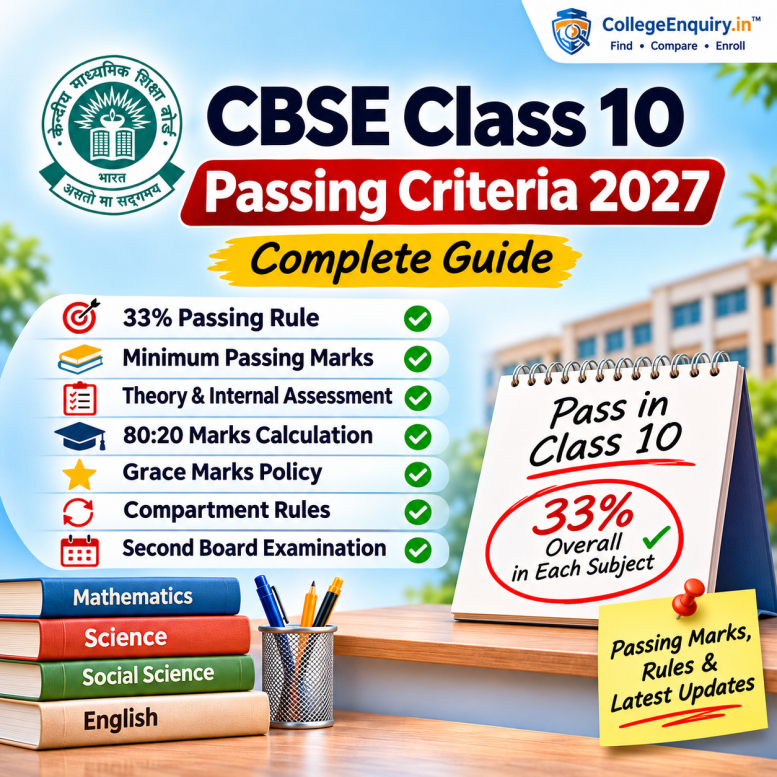
For the 2026–27 academic session, CBSE has clarified that the Class 10 passing requirement continues to be 33% marks overall in each subject, calculated by combining the external board examination and internal assessment marks.
This means students should understand the combined marks calculation rather than assume that they must separately score 33% in theory and internal assessment.
In this article, CollegeEnquiry.in explains the CBSE Class 10 Passing Criteria 2027, minimum marks, 80:20 assessment structure, grace marks, compartment rules and the second board examination policy.
CBSE Class 10 Passing Criteria 2027: Latest Update
CBSE has clarified that the Class 10 passing requirement for the 2026–27 academic session is 33% overall in each subject by combining theory and internal assessment marks.
| Particulars | Details |
|---|---|
| Board | Central Board of Secondary Education (CBSE) |
| Examination | Class 10 Board Examination 2027 |
| Academic Session | 2026–27 |
| Minimum Passing Requirement | 33% overall in each subject |
| Passing Calculation | Theory + Internal Assessment combined |
| Assessment Pattern | 80:20 for subjects following this structure |
| Official Website | cbse.gov.in |
What Is the CBSE Class 10 Passing Criteria 2027?
The CBSE Class 10 passing criteria specify the minimum marks a student must obtain to be declared successful in a subject.
For Class 10, the minimum qualifying requirement is 33% overall in each subject. CBSE calculates the result by combining marks obtained in the external examination and internal assessment.
For example, if a subject has an 80-mark theory examination and a 20-mark internal assessment, the total subject marks are 100. A student needs at least 33 marks out of 100 overall to meet the 33% requirement.
The student does not have to independently secure 33% of the theory maximum and 33% of the internal assessment maximum under the clarified Class 10 criteria.
CBSE Class 10 Minimum Passing Marks 2027
The minimum passing requirement is 33% overall in each subject. The exact marks needed depend on the maximum marks and assessment structure of the subject.
| Total Subject Marks | 33% of Total Marks |
|---|---|
| 100 | 33 |
| 80 | 26.4 |
| 70 | 23.1 |
| 50 | 16.5 |
These are mathematical illustrations of 33% of the stated maximum marks. Actual qualifying calculations, including rounding, must follow the applicable CBSE rules and the subject's assessment structure.
CBSE Class 10 Marks Calculation 2027: 80:20 Rule Explained
Many CBSE Class 10 subjects follow an 80:20 assessment structure. Under this arrangement, the external board examination carries 80 marks and internal assessment carries 20 marks.
| Assessment Component | Maximum Marks |
|---|---|
| Theory / External Board Examination | 80 |
| Internal Assessment | 20 |
| Total | 100 |
Example 1: Student Scores 33 Marks Overall
| Component | Marks Obtained | Maximum Marks |
|---|---|---|
| Theory | 23 | 80 |
| Internal Assessment | 10 | 20 |
| Total | 33 | 100 |
The student's combined score is 33 out of 100. This meets the 33% overall requirement, subject to applicable CBSE result rules.
Example 2: Student Scores 40 Marks Overall
| Component | Marks Obtained | Maximum Marks |
|---|---|---|
| Theory | 25 | 80 |
| Internal Assessment | 15 | 20 |
| Total | 40 | 100 |
The student has obtained 40 marks out of 100, which is above the 33% overall requirement.
Example 3: Student Scores Below 33 Marks Overall
| Component | Marks Obtained | Maximum Marks |
|---|---|---|
| Theory | 20 | 80 |
| Internal Assessment | 8 | 20 |
| Total | 28 | 100 |
The combined score is 28 out of 100, which is below the 33% qualifying requirement. The student's result will be processed according to CBSE's applicable rules.
Is It Necessary to Pass Theory and Internal Assessment Separately?
No. For CBSE Class 10, the clarified passing requirement is 33% overall in each subject by combining the external examination and internal assessment marks.
Students should not confuse the Class 10 rule with the Class 12 passing criteria. CBSE's published clarification distinguishes the two:
- Class 10: 33% overall in a subject by combining theory and internal assessment.
- Class 12: Separate qualifying requirements apply to theory and practical examinations, where applicable.
Students should still complete all internal assessment activities, practical work, projects and school assessments prescribed for their subjects.
CBSE Class 10 Subject-Wise Passing Rules 2027
The 33% overall passing requirement applies subject-wise. However, the assessment components and maximum marks can differ between subjects.
1. Mathematics
Mathematics Basic and Mathematics Standard are two options offered by CBSE at Class 10 level. Students should check their selected subject and the applicable assessment structure.
2. Science
Science assessment includes the prescribed theory examination and internal assessment or practical-related components, as applicable under the subject structure.
3. Social Science
Social Science students should prepare for the board examination and complete school-based internal assessment activities.
4. English and Hindi
Language subjects include the prescribed theory examination and applicable internal assessment components. Students should prepare according to the syllabus.
5. Skill and Other Subjects
Skill-based, vocational and other subjects may have different assessment components. Students should check the official subject curriculum and school instructions for the applicable marks distribution.
Do not assume that every Class 10 subject follows an identical 80:20 structure. The subject-specific CBSE curriculum and marking scheme should be checked before calculating qualifying marks.
Does CBSE Give Grace Marks in Class 10 Board Exams 2027?
CBSE has a policy for awarding grace marks during result computation to candidates who do not meet the qualifying criteria. The applicable policy is used by the Board while processing results.
However, students should not assume that a fixed number of grace marks will automatically be awarded to everyone who fails by one or two marks.
The number of marks, eligibility and application of the policy depend on the Board's applicable rules and result-processing decisions.
- Grace marks are not a guaranteed entitlement for every student.
- CBSE applies its result-processing policy where applicable.
- The Board decides how the policy is applied to qualifying cases.
- Students should not rely on unofficial claims about a fixed grace-mark allowance.
CBSE Class 10 Compartment Rules 2027
A student who does not meet the required passing criteria in a subject may be placed in the Compartment category, subject to CBSE's result rules.
The compartment facility provides an additional opportunity to eligible students to clear the subject in which they have not qualified.
Under CBSE's two-board-examination policy introduced from 2026, students placed in the Compartment category in the first examination are allowed to appear in the second board examination under the applicable category.
What Happens After a Compartment Result?
- Check the result and subject-wise status carefully.
- Verify the applicable compartment category.
- Follow the CBSE notification and school instructions.
- Complete the required examination form or registration process.
- Appear in the permitted examination as per the announced schedule.
The exact process, dates and eligibility conditions should be checked in the relevant CBSE notification for the examination year.
CBSE Second Board Examination 2027: Eligibility and Rules
CBSE introduced the two-board-examination system for Class 10 from 2026. Under this framework, students have a first board examination and a second examination opportunity, subject to prescribed eligibility conditions.
The second examination is not an unrestricted opportunity for every student to appear in any subject. CBSE has specified categories and conditions.
Who Can Appear in the Second Board Examination?
- Improvement category: Eligible students who have passed the first examination may improve their performance in up to three permitted main subjects.
- Compartment category: Students placed in the Compartment category in the first examination may appear in the second examination under the applicable category.
- Other notified categories: Any additional category specifically permitted by CBSE must follow the relevant notification.
Important Rule: First Board Examination Is Mandatory
CBSE has clarified that appearing in the first board examination is mandatory for students.
If a student does not appear in three or more subjects in the first examination, the student will not be allowed to appear in the second examination under the notified policy and may be placed in the Essential Repeat category.
Can a Student Improve Marks in All Subjects?
No. Under the notified improvement category, eligible students who have passed the first examination can improve their performance in up to three permitted main subjects. The permitted subjects and conditions are specified by CBSE.
What Happens If a Student Fails in One or More Subjects?
If a Student Fails in One Subject
The student may be placed in the Compartment category, subject to CBSE's rules. The student should check the result and eligibility for the second board examination.
If a Student Fails in Multiple Subjects
The Board will determine the result category under its applicable examination rules. Students who do not meet the conditions for the second examination may be required to appear in the next main examination cycle.
If a Student Does Not Appear in Three or More Subjects
CBSE's clarification states that such students will not be allowed to appear in the second board examination under the two-examination policy and will be placed in the Essential Repeat category.
Difference Between Compartment, Improvement and Essential Repeat
| Category | Meaning |
|---|---|
| Compartment | For eligible students who do not meet the passing requirement in a subject. |
| Improvement | For eligible students who have passed and want to improve marks in permitted subjects. |
| Essential Repeat | For students required to reappear in the next main examination cycle under applicable rules. |
These categories have different eligibility conditions. Students should not treat them as interchangeable.
How to Check CBSE Class 10 Result 2027?
After CBSE declares the Class 10 result, students can check their marks and result status through the official result platforms notified by the Board.
- Visit the official CBSE website: cbse.gov.in.
- Open the result notification or official result portal.
- Select the Class 10 result link for the relevant examination.
- Enter the required login details.
- Submit the details.
- Check subject-wise marks and result status.
- Download or save the digital marksheet for reference.
How to Prepare to Meet the CBSE Class 10 Passing Criteria?
1. Understand the Official Syllabus
Check the CBSE syllabus for the 2026–27 academic session and identify the chapters prescribed for each subject.
2. Practise Sample Papers
Solve official CBSE sample question papers to understand the question format, marks distribution and examination instructions.
3. Complete Internal Assessment Work
Do not ignore projects, practicals, activities and school-based assessment tasks. Internal assessment marks contribute to the final subject result.
4. Revise Difficult Chapters
Identify weak topics and revise them regularly. Practise numerical problems, diagrams, definitions and written answers as required by each subject.
5. Attempt Full-Length Mock Tests
Solve complete papers within the prescribed time. Use the official marking scheme to evaluate your answers and identify mistakes.
Official CBSE Resources for Class 10 Students
Students should use official CBSE documents to verify the passing criteria, assessment structure and examination rules.
- CBSE Controller of Examinations – Frequently Asked Questions
- CBSE Notification: Two Board Examinations in Class X
- CBSE Clarification on Two Board Examinations in Class X
- CBSE Examination Circulars
- CBSE Academic Website
Related CBSE Class 10 Article
Students preparing for the 2027 board examination can also read our detailed guide on the examination timetable and subject-wise updates.
This article covers the expected examination timeline, Phase 1 and Phase 2 schedule, Mathematics exam pattern, sample papers and other date-sheet updates.
Frequently Asked Questions (FAQs)
1. What are the CBSE Class 10 Passing Criteria 2027?
Students must secure at least 33% overall marks in each subject by combining theory or external examination marks with internal assessment marks, as applicable.
2. How many marks are required to pass CBSE Class 10 out of 100?
A student needs at least 33 marks out of 100 in a subject to meet the 33% overall passing requirement, subject to CBSE's result-processing rules.
3. Is 33% required separately in theory and internal assessment in Class 10?
No. CBSE has clarified that Class 10 students need 33% overall in each subject by combining external examination and internal assessment marks.
4. What are the passing marks out of 80 in CBSE Class 10?
If a subject has 80 marks as its total maximum, 33% is 26.4 marks, with the applicable qualifying calculation and rounding governed by CBSE. For an 80-theory plus 20-internal subject, the combined total is 100 marks and the overall requirement is 33 marks.
5. What is the CBSE Class 10 80:20 marking scheme?
Under the 80:20 structure, the external board examination carries 80 marks and internal assessment carries 20 marks, making a total of 100 marks.
6. Can a student pass with 25 marks in theory and 10 marks in internal assessment?
If the subject follows an 80:20 structure, the combined score is 35 out